Personalisation based on Agent Systems
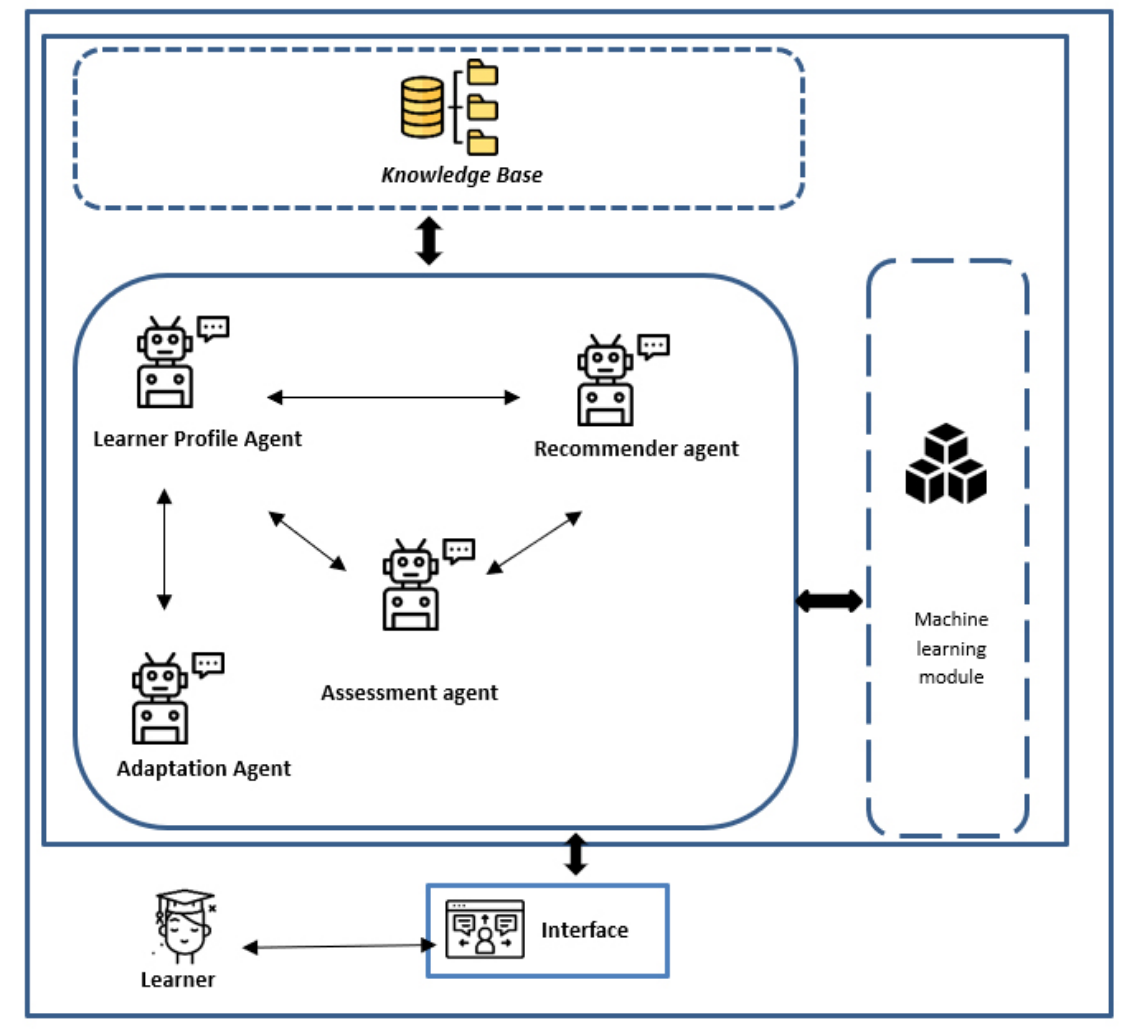
This involves the adaptation (personalisation) of learning content through the use of agent-based systems. These systems provide automation capabilities, where multiple agents work together to dynamically tailor educational content and learning experiences to individual learner needs. They consist of different components (agents), each responsible for specific system functionalities. For example, the content agent is responsible for personalising learning materials according to learners’ needs, while the student agent focuses on identifying key learner characteristics and information.
Examples of multi-agent systems include AI-based intelligent tutoring systems, recommendation systems, and platforms such as Kira Learning.
Resources
- AI Agents in Education: Top Use Cases and Examples - (article)
- EduPlanner: LLM-Based Multi-Agent Systems for Customized and Intelligent Instructional Design - (video)
- Exploring the Role of Multi-Agent Systems in Education - (video)
- AI and Personalized Learning: How Algorithms are Enhancing Student Learning Experiences - (article)
References
- Anoir, L., Chelliq, I., Khaldi, M., & Khaldi, M. (2024). Design of an intelligent tutor system for the personalization of learning activities using case-based reasoning and multi-agent system. International Journal of Computing and Digital Systems, 16(1), 459–469.
- Burov, O. Yu., Pasko, N. B., Viunenko, O. B., Agadzhanova, S. V., & Ahadzhanov-Honsales, K. H. (2025). Using intelligent agent-managers to build personal learning environments in the e-learning system. In CEUR Workshop Proceedings (Vol. 3918, pp. 125–133). https://www.scopus.com/inward/record.uri?eid=2-s2.0-85217838656&partnerID=40&md5=c27322f2364d68c819589b04110e17ac
- De Meo, P., Garro, A., Terracina, G., & Ursino, D. (2007). Personalizing learning programs with X-Learn, an XML-based, “user-device” adaptive multi-agent system. Information Sciences, 177(8), 1729–1770. https://doi.org/10.1016/j.ins.2006.10.005
- ElSayed, K. N. (2014). Individual syllabus for personalized learner-centric e-courses in e-learning and m-learning. International Journal of Advanced Computer Science and Applications, 5(6).
- Gonnermann-Müller, J., Haase, J., Fackeldey, K., & Pokutta, S. (2025). FACET: Teacher-centred LLM-based multi-agent systems—Towards personalized educational worksheets. arXiv preprint arXiv:2508.11401.
- Jeong, H.-Y., Choi, C.-R., & Song, Y.-J. (2012). Personalized learning course planner with e-learning DSS using user profile. Expert Systems with Applications, 39(3), 2567–2577. https://doi.org/10.1016/j.eswa.2011.08.109
- Laeeq, K., Memon, Z. A., Abbasi, M. A., Awan, S. A., & Khan, A. A. (2024). Integrated modular approach to provide optimized VLE for learners’ engagement. Multimedia Tools and Applications. https://doi.org/10.1007/s11042-024-20100-6
- Mohamedhen, A. S., Alfazi, A., Arfaoui, N., Ejbali, R., & Nanne, M. F. (2024). Towards multi-agent system for learning object recommendation. Heliyon, 10(20).
- Nadrljanski, M., Vukić, Đ., & Nadrljanski, D. (2018, May). Multi-agent systems in e-learning. In 2018 41st International Convention on Information and Communication Technology, Electronics and Microelectronics (MIPRO) (pp. 0990–0995). IEEE.
- Xu, D., Huang, W. W., Wang, H., & Heales, J. (2014). Enhancing e-learning effectiveness using an intelligent agent-supported personalized virtual learning environment: An empirical investigation. Information & Management, 51(4), 430–440. https://doi.org/10.1016/j.im.2014.02.009
- Yee-King, M., & D’Inverno, M. (2015). Pedagogical agent models for massive online education. 1407, 2–9. https://www.scopus.com/inward/record.uri?eid=2-s2.0-84938532490&partnerID=40&md5=d2b20b671a4acb1a5a9983e7044e5451
- Zhang, X., Zhang, C., Sun, J., Xiao, J., Yang, Y., & Luo, Y. (2025). Eduplanner: LLM-based multi-agent systems for customized and intelligent instructional design. IEEE Transactions on Learning Technologies.